
They never change. I used to repair laptops for a well known laptop brand, this was around the release of Windows Vista, 2006 or so.
We were getting a lot of warranty repairs where the issue was “laptop slow” or words to that effect. The only issue with them was that they didn’t have enough ram to run Vista smoothly enough. The whole system chugged. But as there was nothing wrong with the laptops, we’d send them back to the customer largely untouched saying “buy more ram.”
At some point, a couple of suits from the company came to look around the warehouse and meet the team. I was primary diagnostic at this point, so I would inspect most of the laptops and confirm their issues. I was getting around 15 laptops a day at this point that were just low ram for Vista, so I asked the suits “why do we sell laptops with Vista that can’t run it properly as they don’t have enough ram?”
His response was that “Microsoft sets the specs of the laptops. Nothing we can do.”
I’ve been looking up used laptops lately.
I can get a lenovo carbon from 7-8 years ago with 16Gb RAM for 200€.
Meanwhile, my old Linux laptop is chugging along quite happily with 2GB.
Which distro/setup do you use? I tried loads on my old 4GB macbook air and they were all dog-slow unfortunately.
Gallium OS (now defunct, sadly), with a somewhat outdated version of XFCE.
I know, I know. It would be better if I was using a more updated Linux version, and some of the stuff on it is horrifyingly outdated. (I forget what kernel it’s on, but the version number starts with a 4.) But while Gallium OS is no longer maintained and updated, I still want to use it for the old Chromebook because it has a custom-altered kernel that plays especially nice with Chromebook hardware. It runs very efficiently (17+ hours of battery life), and all the weird Chromebook hardware quirks work flawlessly out of the box. So far, it hasn’t caused me any issues*, and I’ll keep using it like this as long as it remains issue-free.
*The one issue I’ve had from the outdated OS is that I haven’t been able to install FadeIn for Linux. It requires a more recent kernel version than Gallium ships with, and I can’t update Gallium’s kernel without losing the unique features that make it run well on Chromebook hardware.
If anybody ever makes a successor to Gallium OS optimized for Chromebook hardware but using modern, updated Linux packages, I’d love to know about it!
Judging from my experience here, I’d recommend looking into it and seeing if you can find any distros that are especially tailored to old Apple hardware. If such a thing exists, I bet you’ll get much better results with it.
I think FydeOS is like Gallium: https://fydeos.io/
But I see Gallium was built on Xubuntu, so presumably Xubuntu should also just work for you.
Otherwise, Peppermint and Puppy Linux are message for older low ram devices as well, and lastly, if you haven’t already, you might want to look into mrchromebox:
Thank you for taking the time for such a detailed response. My MacBook got a frustrated toss in to a skip unfortunately, as it had a duff battery and the hinges were loose. I was asking for my next (unavoidable) project, as low spec hardware always seems to come along and find me!
That’s actually…impressive
What do you typically use it for though? My PC is central to the media I consume, the games I play and as a creative outlet. I don’t think I’d be able to use most of the tools I enjoy with such little memory.
It’s not my main workstation or gaming PC, which is probably why 2GB is plenty comfortable enough.
Light web browsing, printing stuff, word processing, running presentations at my writer’s group, occasionally running a Game Boy emulator or playing a video … never anything particularly demanding. I only use it when I need the portability, because otherwise why would I want to do things hunched over a tiny laptop?
All very light uses, sure … but for that kind of stuff, it does great. Feels responsive and snappy pretty much all the time, despite being a shitty old Chromebook from 2016.
*DDR3
Microsoft can fuck right off! Thank you very much.
I was happy with my 16gb until I went to make a small edit to something in Starfield and saw the system requirements for the toolset needs 32gb just to load the core game’s master files. Without even trying to open the 3D graphical view of a map cell or any DLC esms, it easily takes 12-14gb just to have the damn .esm loaded in.
Now you can have a slow computer that dies in exactly 6 months.
That’s alright, you can just buy another one!
Laughs in MacBook neo (which is surprisingly CHEAPER than this?)
Its so tempting to get one, they seem really legit
They are and it’s easy to mod them to improve cooling and increase performance as well.
I find it strange how unwilling Microsoft is to be price competitive with Apple. It really shouldn’t be that difficult to price comparably to apple
Apple spent decades perfecting their hardware production while Microsoft relied on third party sellers to create devices that would run Windows. Why would you expect their hardware to be comparable at this point? They’re primarily a software company and their software is also bad
no worries… I’ve replaced more microslop surface hardware then I have sold. I refuse to sell em… nothing but ewaste in 6-8 months with some of the most HORRENDOUS support imaginable because… microsoft
I really like my surface pros, have a 2016 one that still runs great even though the battery is starting to bulge a bit. My mom got a non-pro and had lots of issues.
Yikes you do know a bulging battery is a fire risk right?
Using win 11 with 8gb of ram should be the sentence for nonviolent crimes
Cruel and unusual
I have both Windows 11 and Linux mint on the same PC with 8 GB of RAM. I use it for making slides, research, watching videos, internet browsing and gaming (valorant, counter strike). Windows 11 isn’t unusable at all with 8GB of RAM. It really depends on what your use case is, also depends on the amount of bloatware you have
booting the computer is the use case for the surface l… lol, that’s about all you’re gonna do with 8gb
There are laws against cruel and unusual punishment.
Sadly, not unusual enough
Is it really that unusable? I hate windows 11 as much as the next guy, but on the other hand, my parents both use windows 11 on an 8gb system and they haven’t had any complaints. Granted they pretty much only do things in a webbrowser.
If you do anything heavier than just a browser, you’re gonna have issues. I had a bunch of users on 8gb laptops one upon a time. If they tried to run excel, outlook, and chrome at the same time their systems would run like it was 2003.
Yeah that doesn’t surprise me, especially with how much ram windows 11 needs just to run without anything open. So far 8 gigs still seems to work fine for their usecase, and i didn’t really notice any bottlenecks whenever i was troubleshooting on their machines either. If anything the cpu ended up being more of an issue, the oldest of the 2 had a ryzen 2200g in it, and i noticed it would often spike up to 100% in task manager without doing much. I had to upgrade it anyway since windows 11 required a newer cpu for secure boot, so i put a 3400g in it and now it runs smooth again, still with 8 gigs of ram.
I doubt that web browsing is good either with how modern web apps are built. But regular people might not even realize that something is wrong.
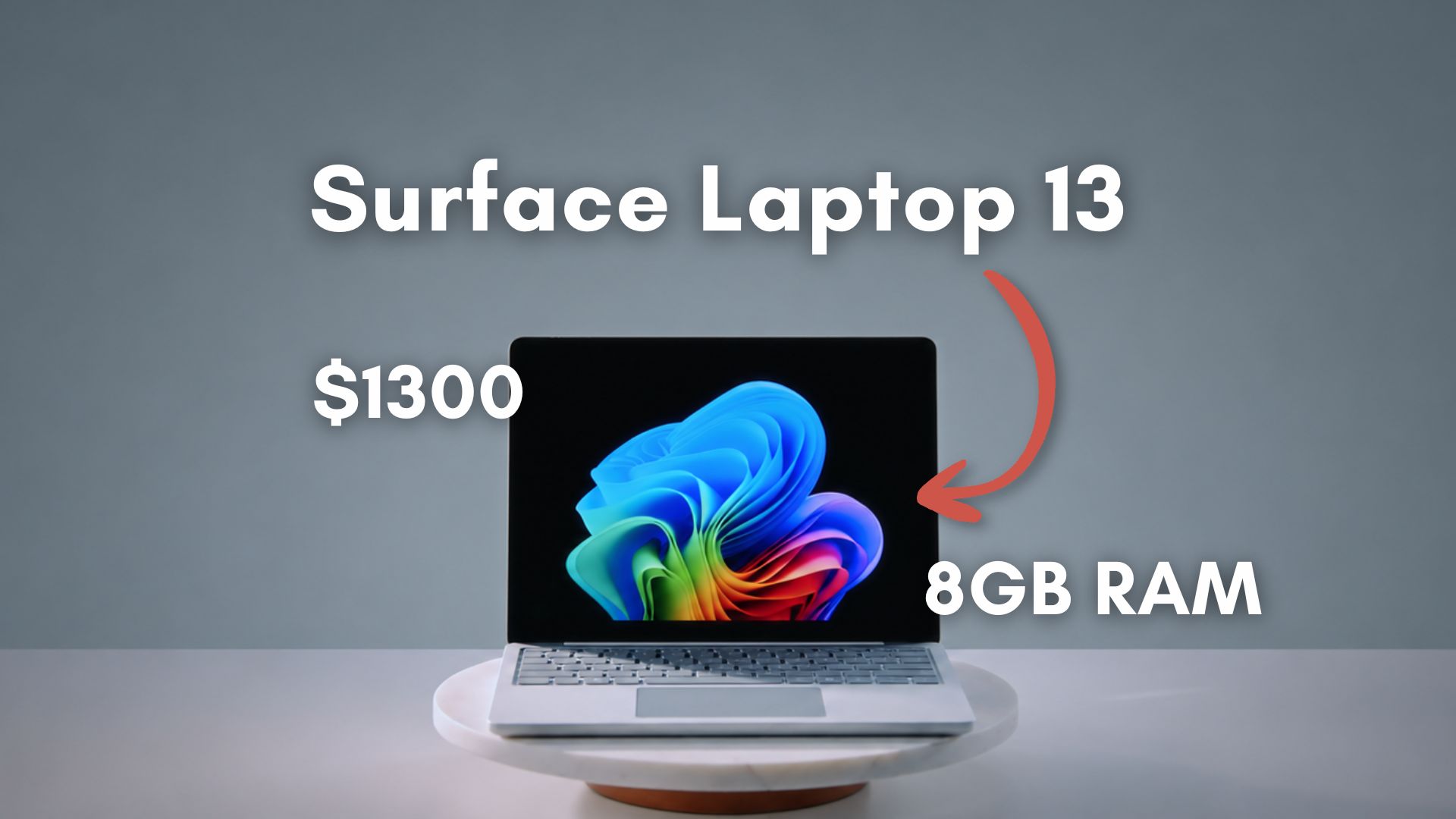
This statement is fundamentally wrong. Asking enterprise users to settle for 8GB of memory in a premium $1,299 machine in 2026 is the definition of trading off performance and will tarnish the Surface brand’s reputation for long-term reliability.
In what world are surfaces reliable? All I hear from people who get them from work are what absolute pieces of shit these things are.
I use a Surface Pro 9, I bought it new specifically to install Linux on it.
Uninstalled Windows 11 one hour after it’s first bootup and installed Fedora on it, and I am pretty sure most of it’s problems are caused by Windows. On Linux, it is stone cold and dead silent when I am browsing the web, editing text, programming etc. I get about 6 hours of freedom when I got VSCodium and some browser windows open.
For sub 5 minute multicore workloads, the metal case eats all that heat up fairly quickly and I can say the device has very good thermal design. Though it does heat up to “hurts to touch” temperatures when I got hour long heavy workloads like compiling the linux kernel, I did expect that because it is an Intel after all.
I don’t really mind overheating since I don’t hold the device in my hands when I am compiling a giant project, what matters is that it doesn’t heat up in my hands when I am watching movies and stuff.
Plus; my favourite desktop GNOME is wonderful on touchscreens, I love their HIG, it is so comfortable. I can’t imagine the poor souls having to navigate Windows UI on a touchscreen.
My surface pro is okay whenever I have to take a windows laptop to a job site. The unreliability comes from Windows 11, but the hardware has been fine.
Hell you can have an overspec’d gaming PC and Windows still sucks the life out of it.
No, I am talking about the hardware. At least 4 seperate people I’ve spoken to had nothing but issues with work assigned surfaces. At least a cursory google turned up a few threads with similar sentiments.
Work assigned laptops are usually treated very poorly and die early.
Surfaces have pretty solid hardware (repairablity like is like Mac’s) and they work pretty well with Linux.
Hell you can have an overspec’d gaming PC and Windows still sucks the life out of it.
Never heard of such a thing? Care to elaborate?
Not that I’m defending Windows, it’s a POS
They are trash like any other laptop as thin and unventilated as that.
They are trash like any other laptop as thin and unventilated as that.
I mean, it depends on what you’re using a laptop for.
Like you, I have pretty consistently also pointed out, when people talk about, say, doing heavy LLM crunching on laptops, that the form factor just is not great for heat dissipation or using a lot of power.
But, I mean, that’s not everything that people do on a laptop. I’m writing a comment on a Lemmy Web page right now. That’s not a terribly compute-intensive task.
Honestly, what irks me more about thin laptops is that they invariably have limited battery size. I’d be quite happier with a thicker laptop if it meant 100 Wh batteries, but most laptop vendors have smaller batteries. Lithium batteries are a lot cheaper in 2026 than they were some decades back. A lot of laptops ship with something like a 50Wh battery. Sure, it’s great to shave down cost, and a lot of consumers don’t think about battery life when buying a laptop, but in 2026, it’s less than ten cents per watt-hour for lithium-ion cells. From my perspective, the return here is just not great.
Yeah, we’ve also generally improved power efficiency, and USB PD is a thing, so you can carry powerstations, but I’d rather have a laptop that knows how much time it has left and don’t need to haul out an external battery and eat up a USB-C port. And you can always do something useful with laptop battery life. Brighter screens. More USB-connected devices. Degrading your battery less over time by not completely charging and discharging it. More fan cooling, more CPU capability, more GPU capability. The only people who don’t get anything out of more battery are people who always use their laptop as a portable desktop, never use it unless it’s plugged into wall power.
There’s some weight argument, maybe, but if that’s what you want, back when lithium batteries were more expensive, a number of laptop vendors used to provide the option of smaller batteries, often shipping laptops with an option of a smaller battery or a larger (more expensive) one. That could still be done today, and if you have a smaller battery, the laptop is lighter.
I can maybe understand someone arguing some thinness benefits from an ergonomic standpoint, but…desktop keyboards are almost always thicker than laptops. Desktop touchpads that I’ve seen generally are as well. If, given a situation where you don’t have size constraints for actual usage, users choose thicker devices, it’s hard for me to see the argument for a laptop form factor.
In general a mobile device should not be running windows
Should not be used for heavy lifting
Should not be a desktop drop-in replacement
Should not be expensive. Or at least, not THAT expensive.
It still baffles my mind that I can use an android phone docked to a keyboard, mouse, and monitor, and have a better experience on the go than using a laptop that costs 3 times as much as that entire setup. People have done this on YouTube, it’s a great watch.
The issue imho is that consumers that buy laptops have no idea what they are buying so companies can get away with pretty much anything. If it turns on and runs chrome and excel the user is happy to spend $1500… For some stupid reason…
I’ve bought a Surface Go 2 a few years back and the startup time has steadily risen from a poor ~2min to well over 5min. But ever since I’ve deactivated secure boot and installed Debian with Plasma, it’s become my beloved workhorse with a boot time of <1min after entering the LVM key.
Surfaces are great hardware for the (old) price. A pity hardware’s becoming unaffordable…
You mean with Windows?
From my favorite e-waste retailer I saw that the pricing of surface go 2 and 3 is enticing and I wanted to try them - but with Linux. With Linux is usable, right? Plasma can recognize tablet mode automatically?
I do mean with Linux. I bought it with Widows on and eventually put Debian on it. KDE Plasma already does a wonderful tablet mode out of the box and it’s getting better. The stylus isn’t all that reliable yet.
What what other people in this thread are saying, Linux on a surface is really solid.
At my last job while doing a lot of win 11 computer replacements, I managed to snag a couple of laptops that were going to be ewasted. One I keot for myself was an early surface. SSD and RAM are soildered to the motherboard so no upgrade or replacement path. Runs warm and the cpu is kinda trash.
Whatever, free computer is free and running mint its usually fine.
Soldered computer components shouldn’t even exist. There are way more downsides with it than up sides - of course it might be faster, but what’s the point if in a year or 2 the capacity will be insufficient. What do you do then? Toss it in the trash?
Honestly, we are going technologically behind. Rather than making proper standards for modularity, they rather make up dozen of excuses of how soldered is actually superior.
What do you do then? Toss it in the trash?
Toss it in the trash and buy a new one.
Now ask yourself again why hardware manufacturers love doing that…
Same thing in automotive industry tbh. No fucking reason why every vehicle a lineup doesn’t share modules.
Surface Pro owner. Can confirm - worst computer I’ve owned. Gets hot to the touch when you open Notepad.
Holy shit, they launched a new 4 gig machine in 2022‽
640kb ought to be enough for anybody
Bro’s an AntiX enthusiast. lol
I just run my OS directly off my 5.25” floppy
Everything on a computer is just fancy word processing. Who needs more than a text editor?
I recently got my Casio watch to save 25 phone numbers! And it’s a calculator!
Well, you know what naturally floats on the surface…
A witch?
We found one! May we burn her?

I am ashamed of my toilet humor in front of experienced scholars.
Laughs in Raspberry Pi running retro games in Linux on 4GB of RAM.
If your only goal is to run retro games, you can get away with a lot less than that!
cuts ram stick in half
Installs Fedora LXqt
That should fix it
Does that fix the price tag?
No, it doesn’t. This is for people that already bought in.