tldr:
* I installed console-only Debian on an old laptop (no desktop OS at all)
* I added some packages to make it work better for writing:
* network-manager for connecting to hotspots while I'm away
* kmscon for custom fonts and more than 16 colors in the tty
* tmux for a nice status


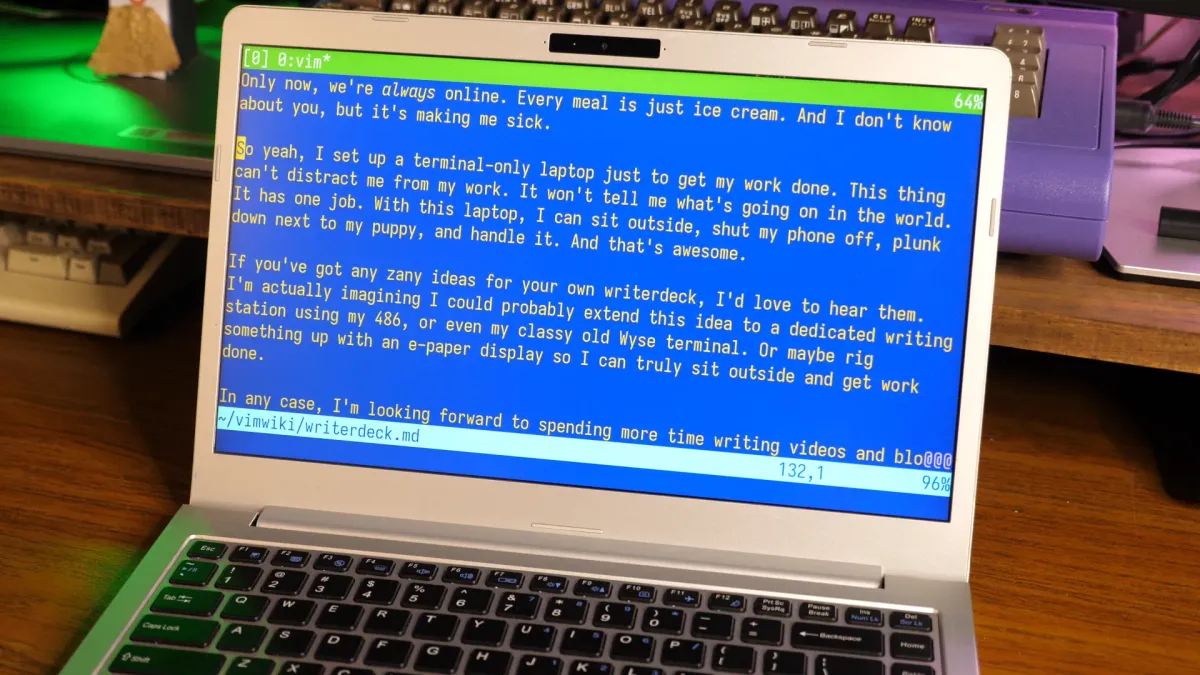
For this application, I am hoping reflective LCDs make a comeback or transreflective LCDs. They are much better for typing than e-ink and still easy on the eyes.
Early apple devices were quite decent out in the sun with the glass screen and transreflective LCDs. I remember my old devices were quite usable even with the not great brightness if I angled it to reflect the sun nicely.
Waveshare just released a fully reflective monochrome small one with an integrated ESP32 so I am hoping that catches on in the hobbyist communities and people can start building tech decks with bigger screens that aren’t 800€ and a 1Hz refresh rate.
E-paper is amazing for static text, images (see pimorino screens with E-Ink 6color), labels, and status things, but fast typing and drawing makes them outrageously expensive for hobbyists and even very expensive at large scale like Boox and Remarkable.
I got the waveshare color e-ink ( https://www.aliexpress.us/item/3256810087715380.html ) to make a custom dashboard display - it is the living embodiment of horrible refresh behavior - no clock on that dashboard. Still, while it’s static it looks really good, you just have to figure out what you want to see on a changeable display that doesn’t change more than a couple of times per hour.
Oh yeah those E-inks have like a 10 second refresh timem they are meant for static art, images, signage, etc…
That is why for clocks and dashboards, I think RLCDs like the https://www.waveshare.com/esp32-s3-rlcd-4.2.htm which is an older tech, but nowadays much better reflection to be closer to e-paper, 60Hz and none of the epaper downsides, but much higher power use.
Yeah, I’ve got mine showing current temperature, forecast and our Google calendar, so it probably refreshes 40-50x per day. The bigger power draw is firing up the WiFi module to check for new information once every 5 minutes. Last battery charge ran about 2 weeks.