


Safety coffins were a big thing in the 1800’s. The fear of premature burial was not entirely without merit. The wiki link mentions that during the cholera epidemic, they didn’t put a very fine point on the difference between “dead”, and “not dead, but we think you will be pretty soon.” Poe has entered the chat.
There was even a London Association for the Prevention of Premature Burial, who agitated for requiring a physician examination before someone was declared dead.
Lots of these contraptions were made, often with bell mechanisms and fresh air tubes for the prematurely interred.
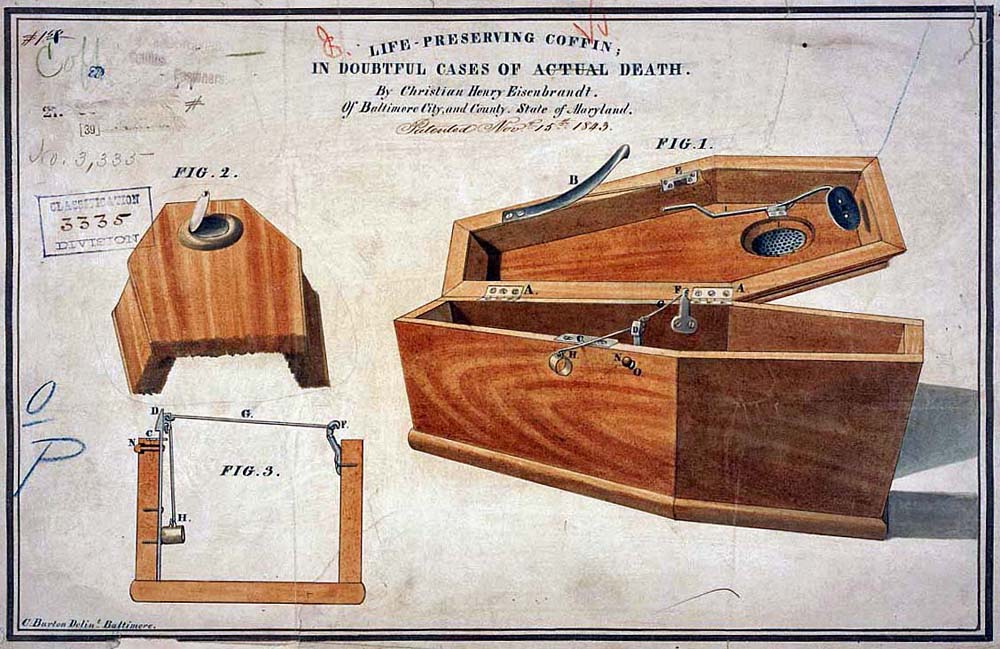
The rise of cremation and embalming more or less ended the risk of premature burial.
[off topic]
My personal favorite Michael Crichton book is “The Great Train Robbery” which he also directed.
The novel presents itself as a serious study of Victorian England using a [totally fictional] crime as the center point. The novel follows the criminals, with long asides on things like prisons, housing, tipping servants, dog fighting, and safety coffins.
Certainly worth a look.
edit = misspelled his name.
Crichton* and this is one I haven’t gotten to
It’s fun to read the book first and then watch the movie.
For example, one thing he writes about are ‘penny hangs’ where people [almost always men] would pay a penny to sleep standing up, leaning on a rope.
If you have that knowledge, the quick glimpse you get of one in the movie stands out.
I’ve read every Michael Crichton book and I’m very surprised that The Great Train Robbery was your favourite. It’s one of the only books I’ve only read once. (Hrm, I think I should put Prey on my list of books to read. Haven’t read that one twice)
I don’t remember much from the book, the scene that stick out the most was the contortionist. I’ll have to give it another read and keep an eye on the history.
EDIT: apparently this is all wrong. “Ringer” was a term for a substitute in a horse race or a fight, and “dead” was used in the sense of “precise” or “exact” like “dead eye.”
Fun fact: we get the term “dead ringer” from the practice of attaching a bell string to a cadaver’s finger and mounting the bell above their grave, so if someone was buried alive they could ring the bell and be disinterred.
Apparently there’s another folklore, also false, that “saved by the bell” referred to this practice. It’s boxing related, which is more plausible, but less fun.
According to the Internet, there is no record of anyone being saved by a safety coffin (false positives, on the other hand…)
False positives sound like an unpleasant process to discover. I wonder how many times those happened.
Edit. Also, though there are no recorded cases of a true positive, I wonder if there were false negatives, like someone really was alive, but nobody noticed the bell, or the mechanism failed in some way. Wikipedia does mention,
and a demonstration in which one of Karnice-Karnicki’s assistants had been buried alive ended badly when the signalling systems failed