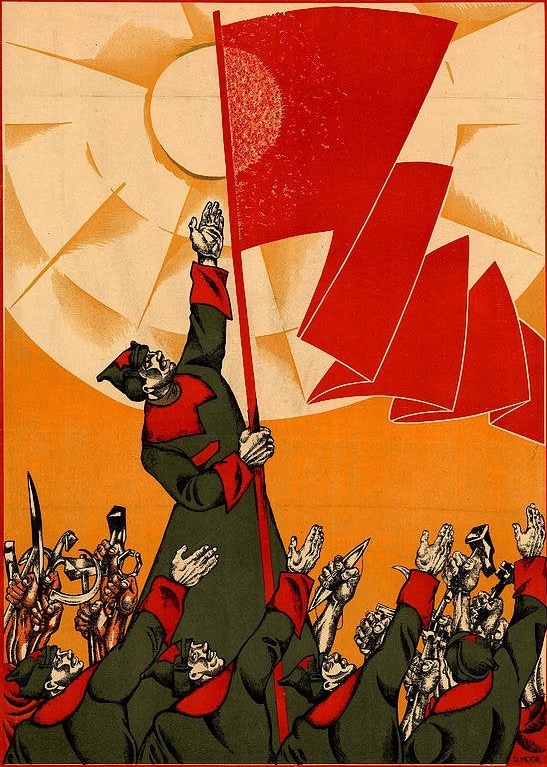
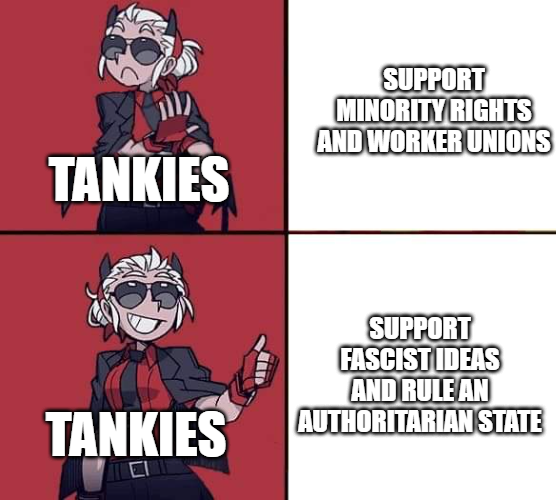
Claiming that we oppose minority rights is pretty ignorant when it is so easy to find examples of us reporting on the IOF’s devastation of Palestine, and every day I see a thread that a Palestinian posted in this instance asking for donations.
Saying that we don’t support worker unions is, likewise, a clueless thing to say. If I thought that none of us supported unions, I would never bother reporting their ongoing struggles. This accusation is not even logically coherent, given that ‘anti-tankie’ chumps frequently oversimplify our politics as ‘America bad’ and the unions here are certainly not making the empire any stronger, so why would we not support them.
Of course, the author’s most blockheaded assertion is that we support fascist ideas, proving that said author has no clue what fascism was. Supporting fascist ideas? Like what? The ‘majority-plus’ electoral system? The ‘personality right’? The collaboration with the upper classes? The abolition of the minimum wage? The establishment of a Ministry of Corporations? The establishment of a ZAST? The elimination of linguistic diversity? The conquest of the Horn of Africa? The reinvasion of Soviet Eurasia? We support all of those?
Now, remind me again: who are the ones approving of a régime that awards Azov members? Hmm?
What world do the Anti-MLs live in? Have they ever thought of picking up a history book?
Not ones written by historians.
Historians in capitalist countries write anticommunist nonsense all the time.
That is also true unfortunately.
Makes no sense, ML states are the global leaders in minority rights and workers unions are given the highest possible support - literally being part fo the government and state apparatus.
Also all ML states kept their bourgeoisie strictly under control and out of actual power, meaning they can not be fascist by definition.
“Authoritarian” is a brain fart, it means nothing (definitionally it applies to every state) without extensive explanations of what one, personally, actually means.
These anti-communists know nothing.
edit: They meant us personally, oops. Everything still applies on a personal level tho.

I mean, I rule an authoritarian state, so it checks out.
OK
- what’s a ZAST\
- what’s so bad about a majority plus electoral system? don’t socialist countries also use those to some extent?\
- What is the personality right
- Zentralauftragsstelle (Central Office for Public Orders). It enabled the coordination of Fascist industrial orders in France, Belgium, and the Netherlands. The ZAST system was pioneered in the Netherlands and accounted for as much as 2–3% of the armaments produced for the Third Reich, in addition to setting off a wartime boom in the Netherlands.
- In the ‘majority-plus’ electoral system, the party that receives the most votes in national municipal elections automatically receives two-thirds of the seats. All seats are contested by a closed and blocked party list system to a single national constituency. As far as I am aware, there is no people’s republic that operates like this.
Click here to read the issues with the ‘majority-plus’ electoral system.
Per ChatGPT:
The ‘majority-plus’ electoral system [that] you’ve described, where the party that receives the most votes in national municipal elections automatically receives two-thirds of the seats, is problematic for several reasons. Below are key issues with this system:
- Disproportionate Representation
The most fundamental problem with this system is its disproportionality. In any electoral system, the goal should be to ensure that the percentage of seats a party receives closely reflects the percentage of votes they win. However, in this system, the party that wins the most votes is rewarded with a disproportionate share of seats — specifically, two-thirds of the seats, even if they don’t win two-thirds of the vote.
For instance, if Party A wins 40% of the votes, they would still get 67% of the seats, while other parties, despite getting a significant share of the votes, receive far fewer seats than they deserve. This creates inequity and distorts the will of the voters.
- Winner-Takes-All Incentive
The system provides a huge incentive for parties to win the largest share of the vote, but not necessarily a majority. Parties will focus on winning the largest plurality rather than striving for a true majority, which could lead to polarization and partisan conflict. It also makes elections less competitive because parties that know that they can’t win the most votes will struggle to gain any representation at all, even if they have a significant base of support.
- Exclusion of Minority Voices
In this system, smaller parties that do not win a plurality of votes may be entirely excluded from the legislature. For example, if three parties are competing and one wins 45% of the vote while the others split the remaining 55%, the largest party would receive two-thirds of the seats, and the other two parties may receive nothing at all. This is particularly problematic in a system where there are multiple parties representing diverse interests. It effectively marginalizes minority voices.
- Closed and Blocked Party List System
The closed and blocked party list system means that voters can’t vote for individual candidates but only for a party’s slate of candidates. This reduces voter choice and can lead to party élites determining who gets elected rather than the electorate. Additionally, the lack of preference votes weakens accountability because voters cannot directly choose their representatives.
With the majority-plus system, the party leadership gains even more power over who gets to sit in the legislature, potentially leading to less democratic control over who represents the people.
- Undermines Legitimacy
When a party receives a large number of seats with only a small plurality of votes, the result can be seen as illegitimate by voters who feel their votes have been unfairly disregarded. The party with the most votes may not necessarily have broad support across society, and giving them two-thirds of the seats might alienate the electorate, causing disillusionment with the political process.
- Potential for Strategic Manipulation
This system encourages strategic voting, where people might vote for the party they dislike the least to prevent the ‘majority’ party from gaining a disproportionate number of seats. This could lead to tactical voting and manipulation, where voters are more concerned about the overall seat allocation than voting based on their true preferences.
- Lack of Political Stability
If this system is used in municipal elections, where local issues may differ significantly from national issues, it can undermine local representation. A party that dominates at the national level may not be as effective or popular at the local level, leading to poor governance and misrepresentation in municipal matters. This misalignment can cause frustration and disconnect between elected officials and local communities.
Wait, I thought you meant the electoral system as “you need a majority, not just a plurality, to win”
No, that was not what I meant. This is what I meant:
The main weapon which Mussolini was to use against his enemies, however, was reform of the electoral system which became law in July 1923 and was intended to provide the Fascists with a solid parliamentary majority.
The ‘Acerbo Law’, as this reform is known, stipulated that the party or alliance of parties which obtained the largest number of votes in excess of a quarter plus one would receive two-thirds of the seats. The remaining seats would then be distributed on the proportional representation principle.
Mussolini’s success in pushing this radical change through parliament can be attributed to a combination of factors. Many liberal-conservatives, including Giolitti, had never liked proportional representation, blaming it for the emergence of the ‘mass’ parties in 1919, for the Liberals’ subsequent loss of control over parliament and for the chronic political instability of the post-war years.
Some opponents of the bill, especially the Socialists, were intimidated by threats of Fascist violence against them and the more vague threat that Fascism would, if necessary, use force to stay in power.
The most important rôle in the debates over the law was played by the P.P.I. The party had always been one of the strongest advocates of proportional representation, but deprived of the leadership of Sturzo, who had been forced by the Vatican to resign in order to appease Mussolini, it split the bulk of its Deputies abstaining but a rightist faction of sixteen voting for.
As Santarelli has pointed out, if the P.P.I. had not split, proportional representation would not have been abandoned and Mussolini might not have been able to use the lists of ‘national concentration’ which in the elections of 1924 permitted him to consolidate his power (Santarelli, 1967, p. 359).
(Source.)
I realize that “Tankies” can be replaced with “U.S. Liberals”. Liberals from other Western nations can have their own lists.
- U.S. Liberals don’t care about minority rights. They will openly work with a government that crushes minorities over and over again in the vain hope that the United States will, somehow, become a fair country that helps people. As Liberals refuse to help minorities if it harms the U.S. government, or breaks its laws, they show a clear preference: minority rights lie beneath the functioning of the United States and its laws, no matter how draconian.
- U.S. Liberals don’t support workers’ unions. I remember that one court case where a workers’ strike was shut down by the House.
- Liberals support numerous fascist ideas, such as the War On Terror, the need to support Israel and silence its critics, the acceptance of austerity measures, the cheering on of the military, and the funding of corporations that in turn fund many Liberal campaigns, as well as Conservative ones.
- Liberals rule over the United States of America, even when they themselves admit it to be authoritarian, so they can make the measly attempt to “retake power”. The rule is also over all the territories and protectorates of the United States who have no say in who rules over them.