

link to open access paper
https://journals.plos.org/plosone/article?id=10.1371%2Fjournal.pone.0338509
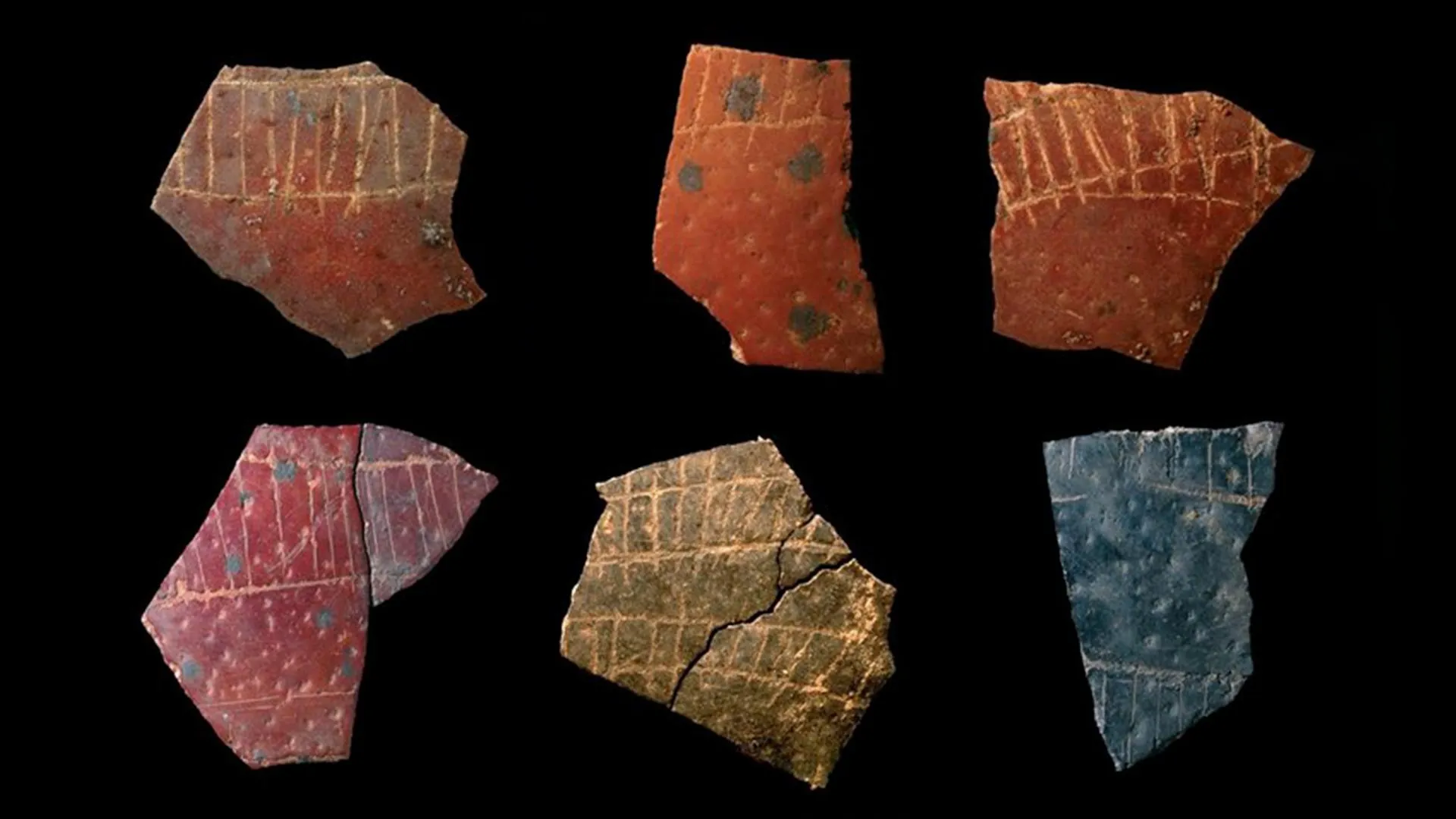
The results demonstrate that Homo sapiens during the late MSA mastered precise, pre-planned patterns anchored in specific geometric affordances: orthogonality and parallelism. These affordances were related and organized through a distinct set of cognitive operations: rotation, translation, iteration, and embedding.
Our dataset is particularly well represented by rotation, translation, and iteration, as these operations enable the construction of simple yet recurrent combinations, including aligned sets of lines and repeated angular configurations. Notably, the analysis revealed that some of these combinations generate a defined spatial framework within which embedding occurs. This framework represents a zero level—a reference plane—within which features and operations are nested to form highly structured, regularly spaced patterns such as hatched bands, grids, and diamonds.
What emerges is a ‘geometric grammar’, that is a coherent and procedural system of operations through which patterns are constructed according to a stable internal logic.

Fig 2. A synthesis of a spatial and chronological assessment of the EOES motifs. Data elaborated from Texier et al. [2]; Heshilwood et al. [3]; Jacobs et al. [29]. We have associated the two fragments from Apollo 11 to the ‘sub-parallel intersecting lines motif’ as, in our statistical analyses, they display the same values in terms of regularity of line alignments, consistent with the fragments in the same category from Diepkloof.
doi:10.1371/journal.pone.0338509.g002
One of my favorite books. Though I have to read it with 10 Wikipedia tabs opened.
Yeah that’s more than understandable, it’s dense as fuck, but well worth the effort!
I made my book club read it a couple of years ago. A few people did the audiobook. Even though I think it might be one of the most important and fascinating books of the last century, I cannot imagine the soporific power of that audiobook.