- cross-posted to:
- fediverse@lemmy.zip
- piefed_meta@piefed.social
- cross-posted to:
- fediverse@lemmy.zip
- piefed_meta@piefed.social
This is my first open source project, apart from tiny bits of code that no one ever paid any attention to. Maybe I don’t know how to do open source properly, maybe I made a mistake here. Let’s find out.
The only missing part was the copyright from the original project, or some kind of attribution. But you’re always free to steal code from an open-source project if you both have the same license.
Yeah this is ridiculous. Neither project has copyright notices in preamble comments at the top of files, or an AUTHORS.txt, or any other kind of copyright notice. Therefore there is no copyright notice to preserve as stipulated by the AGPL. While it’s best practice to preserve Git authorship by using properly formatted patch files (like he did for the first commit), this isn’t technically required.
It’s also debatable whether the stylesheets copied here are even substantial enough works to qualify for copyright to begin with, but that’s another discussion.
The Piefed author should merge all that code right back in, but use
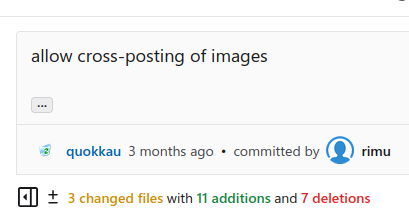
git format-patchfor both commits so Git authorship is preserved. If the fork fellas don’t like that, they should shutter their fork and go fork a project with a more permissive license that allows them to relicense to closed source.edit: I imagine the only reason the Pylova fork authors even cared or noticed is that the stylesheet commit showed up as a merge conflict when they were merging in upstream code – something that would not have happened if the code was merged in using a proper patch file. My guess is that there was a game of broken telephone at play here when the Piefed author heard about this from some third party.
Instead of doing that, I’d just fetch their commits and merge them directly. That has the added benefit of not generating new commits with new hashes (making it easier on the fork’s side). If the original commits were signed, it would also preserve those signatures.
Agreed on this part though. Although the license, under section 5, states “a) The work must carry prominent notices stating that you modified it, and giving a relevant date.” One could maybe argue this wasn’t done for the second change, but if that were to be merged in properly with git attribution intact (which also includes timestamps), that should also be fine.
This is definitely in line with the free software philosophy. It should be possible to include others’ improvements to your project, if you’ve already got their modified source code. And “stealing” code is not even a thing (it’s copyright infringement at worst, never theft).
In this case there was no modification as the code was copied verbatim.
True, I didn’t consider that (though there may have been modifications made after the code was copied?). In that case, section 4 would apply, which only requires keeping notices intact, and there aren’t any as you said.
It does have this clause:
A bit unsure in how that should be taken in this case. There weren’t any notices in the fork, and the copyright information is otherwise the same (the
LICENSEfile). This could also be taken to mean attribution, maybe (since most copyright notices include the author’s name), in which case git author info would’ve probably been enough too.Yeah that’s kind of the point of having open source projects after all :)