However, in the short term the yuan is the obvious choice here because China makes things absolutely everybody needs. So, if you’re holding yuan, you can always convert it into some usable good.
This is also, in a very simplified way, essentially how the dollar became the global reserve currency. It was simply that, for a time, the US was the world’s number one manufacturing power. Everyone needing to buy US goods meant they needed to hold dollars.
Later you had the petro-dollar, but even that was predicated on the global US dominance that was built on that manufacturing power. Once the center of world manufacturing shifts - and it clearly has - the foundations of the old global reserve currency begin to crumble, same as happened with the British pound.
There is obviously a lot of inertia in the current system which is why the loss of financial primacy can lag decades behind the loss of manufacturing primacy, and residual global military dominance also plays a role in artificially prolonging the process, but ultimately it is inevitable.
How exactly this transition will happen is complicated and you can get lost in the weeds discussing all sorts of details like currency swaps, bond yields and the like. It’s a bit like that experiment where you drop a ball through an array of pins where the exact path that the ball takes is very hard to predict. But you know that sooner or later it ends up at the bottom because there is a force of gravity pulling it down.
The shift of the world’s industrial manufacturing center away from the US is that inevitable force of gravity, and no matter how convoluted the path is or how much certain global forces struggle to delay the process, the broad trajectory toward de-dollarization is determined by the fundamental material reality of production.
That being said, i am not necessarily convinced that the Yuan will become the new dollar because China has a very different philosophy in their approach to monetary policy than the US, but we will definitely be living in a post-dollar world, one where the Yuan has perhaps a sort of primus inter pares position in global currencies.
I’d argue that the petrodollar was just a natural transition as the US started outsourcing more industry abroad. Every modern economy needs oil and you could only by it using dollars. That’s been at the core of driving global demand for the currency sine the 70s.
And completely agree that while near term is going to be chaotic and unpredictable, the general trend here is clear because that’s what the new selection pressures are pushing global economy towards.
I do think that it’s fairly likely that BRICS goes through with the idea of a Bancor equivalent at some point. I mostly see the yuan being seen as a convenient stop gap.

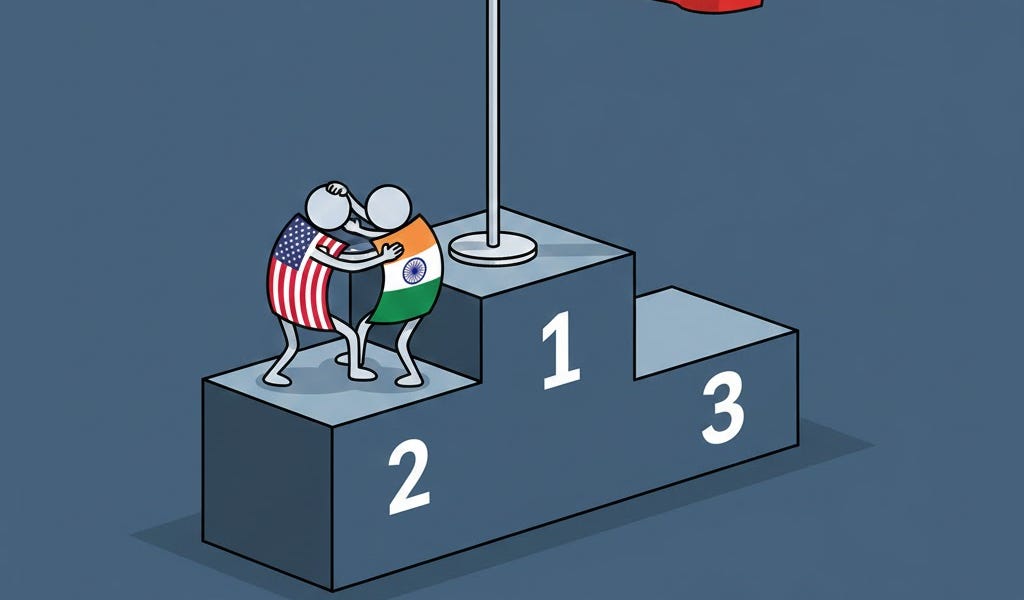
This is also, in a very simplified way, essentially how the dollar became the global reserve currency. It was simply that, for a time, the US was the world’s number one manufacturing power. Everyone needing to buy US goods meant they needed to hold dollars.
Later you had the petro-dollar, but even that was predicated on the global US dominance that was built on that manufacturing power. Once the center of world manufacturing shifts - and it clearly has - the foundations of the old global reserve currency begin to crumble, same as happened with the British pound.
There is obviously a lot of inertia in the current system which is why the loss of financial primacy can lag decades behind the loss of manufacturing primacy, and residual global military dominance also plays a role in artificially prolonging the process, but ultimately it is inevitable.
How exactly this transition will happen is complicated and you can get lost in the weeds discussing all sorts of details like currency swaps, bond yields and the like. It’s a bit like that experiment where you drop a ball through an array of pins where the exact path that the ball takes is very hard to predict. But you know that sooner or later it ends up at the bottom because there is a force of gravity pulling it down.
The shift of the world’s industrial manufacturing center away from the US is that inevitable force of gravity, and no matter how convoluted the path is or how much certain global forces struggle to delay the process, the broad trajectory toward de-dollarization is determined by the fundamental material reality of production.
That being said, i am not necessarily convinced that the Yuan will become the new dollar because China has a very different philosophy in their approach to monetary policy than the US, but we will definitely be living in a post-dollar world, one where the Yuan has perhaps a sort of primus inter pares position in global currencies.
I’d argue that the petrodollar was just a natural transition as the US started outsourcing more industry abroad. Every modern economy needs oil and you could only by it using dollars. That’s been at the core of driving global demand for the currency sine the 70s.
And completely agree that while near term is going to be chaotic and unpredictable, the general trend here is clear because that’s what the new selection pressures are pushing global economy towards.
I do think that it’s fairly likely that BRICS goes through with the idea of a Bancor equivalent at some point. I mostly see the yuan being seen as a convenient stop gap.