The central banks of India and the UAE set up a swap line, agreeing to exchange, say, a pile of rupees for a pile of dirhams. Then when an Indian refinery needs to buy UAE oil, it pays in rupees to its bank.
Are the swap arrangements temporary or permanent (ie they have to swap back at later date with interest). Because if it’s permanent it becomes more of a Net Transfer (a bit more complicated but it’s similar) , and India would be able basically getting something by giving its own currency, what would UAE do with these Rupees? You might say invest in Indian Govt bonds, but then you get Rupees only. Maybe FDI/FPI, but when India and Russia were trying Rupee-Ruble arrangement in 2022, Russians were reluctant.
On central banks buying gold, framing it as turning dollars into more dollars later is a wild misinterpretation of their motive. They’re not day traders. They’re risk managers. After watching the US freeze half of Russia’s reserves, buying gold is about getting a real asset with no counterparty risk. It’s de-dollarization 101 as opposed to some yield play.
Sure
First off, the whole bond yield thing. It’s not that yields are magically pegged. When a central bank does QE, it’s literally buying up its own debt in massive quantities, which artificially pushes the price up and the yield down. The value gets destroyed over time because that policy, if it goes on too long, invites inflation. Inflation eats the fixed coupon of the bond for breakfast. So the loss is real, either as a capital loss if you sell or as a silent erosion of purchasing power. The stable DXY lately is more about relative misery than dollar strength.
Natural rate of interest is zero if the Government runs a deficit under floating exchange rates, Treasuries are an interest-bearing savings instrument provided by the Fed. Inflation depends on aggregate demand, not on whether numbers exist on computers somewhere.
So the loss is real, either as a capital loss if you sell or as a silent erosion of purchasing power.
If you hold Dollars, the only risk-free interest bearing asset is Treasuries (IOR exists too but only for certain institutions). If you are buying any other currency you are taking exchange rate risk instead of supposed inflation risk.
The services surplus and those rock solid remittances bring in the real dollars year after year. Meanwhile capital flows are fickle money that’s chasing yield, and it can reverse in a heartbeat when global risk sentiment shifts or the Fed hikes rates. That’s a volatile source to depend on for funding something as essential as oil and electronics imports.
That is true. But it doesn’t change the part that any flows are better than no flows since it allows the country to run larger trade deficits than it would be able to without it.
The whole idea would be to do what Keynes was suggesting with Bancor. You don’t try to stock up on currencies, but instead simply treat them as a balance ledger. BRICS have already been talking about creating a Bancor like currency to do precisely that which addresses the issue of holding currency of the other country which you might not want to redeem for anything a particular country makes. However, in the short term the yuan is the obvious choice here because China makes things absolutely everybody needs. So, if you’re holding yuan, you can always convert it into some usable good.
Natural rate of interest is zero if the Government runs a deficit under floating exchange rates, Treasuries are an interest-bearing savings instrument provided by the Fed. Inflation depends on aggregate demand, not on whether numbers exist on computers somewhere.
The point is that if the currency ends up becoming devalued faster than the rate of appreciation of the bonds, then you’re losing money. And that’s compounded by the risk of the US having a financial crash which is where the whole house of cards can get kicked over.
If you hold Dollars, the only risk-free interest bearing asset is Treasuries (IOR exists too but only for certain institutions). If you are buying any other currency you are taking exchange rate risk instead of supposed inflation risk.
It’s obviously not risk-free given the state of the US economy, and you’re far better off putting your money into either physical assets such as gold, silver, rare earths, or holding yuan which is backed by a far stronger economy in China.
That is true. But it doesn’t change the part that any flows are better than no flows since it allows the country to run larger trade deficits than it would be able to without it.
Yet, these flows do not have to happen in dollars. It’s not some law of nature that the dollar has to be at the center of international trade. And you only have to look at how quickly dollar took over from the sterling to see how fast things can change when the conditions that underpin global reserve are no longer present.
However, in the short term the yuan is the obvious choice here because China makes things absolutely everybody needs. So, if you’re holding yuan, you can always convert it into some usable good.
This is also, in a very simplified way, essentially how the dollar became the global reserve currency. It was simply that, for a time, the US was the world’s number one manufacturing power. Everyone needing to buy US goods meant they needed to hold dollars.
Later you had the petro-dollar, but even that was predicated on the global US dominance that was built on that manufacturing power. Once the center of world manufacturing shifts - and it clearly has - the foundations of the old global reserve currency begin to crumble, same as happened with the British pound.
There is obviously a lot of inertia in the current system which is why the loss of financial primacy can lag decades behind the loss of manufacturing primacy, and residual global military dominance also plays a role in artificially prolonging the process, but ultimately it is inevitable.
How exactly this transition will happen is complicated and you can get lost in the weeds discussing all sorts of details like currency swaps, bond yields and the like. It’s a bit like that experiment where you drop a ball through an array of pins where the exact path that the ball takes is very hard to predict. But you know that sooner or later it ends up at the bottom because there is a force of gravity pulling it down.
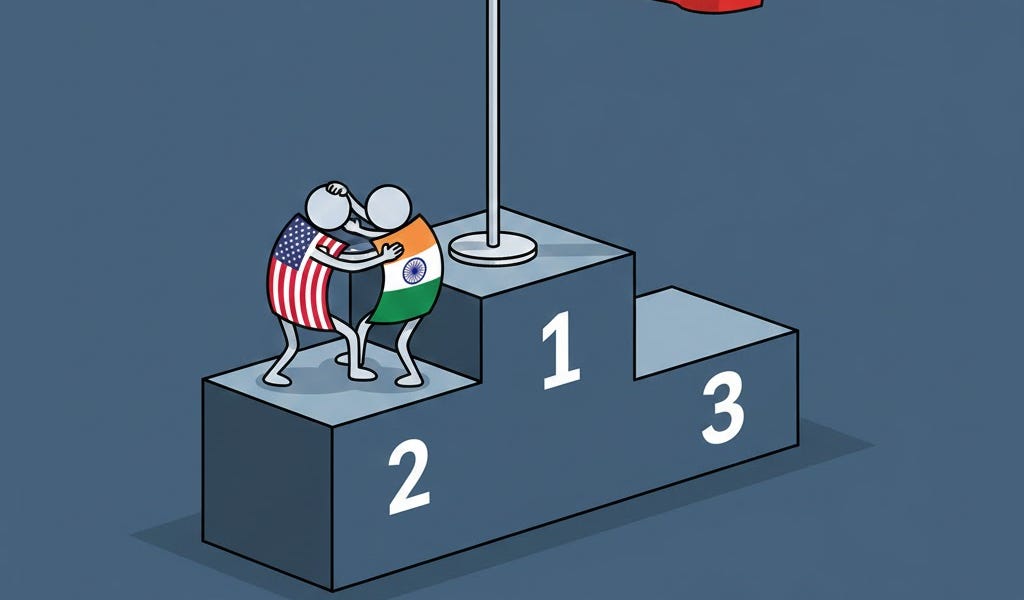
The shift of the world’s industrial manufacturing center away from the US is that inevitable force of gravity, and no matter how convoluted the path is or how much certain global forces struggle to delay the process, the broad trajectory toward de-dollarization is determined by the fundamental material reality of production.
That being said, i am not necessarily convinced that the Yuan will become the new dollar because China has a very different philosophy in their approach to monetary policy than the US, but we will definitely be living in a post-dollar world, one where the Yuan has perhaps a sort of primus inter pares position in global currencies.
I’d argue that the petrodollar was just a natural transition as the US started outsourcing more industry abroad. Every modern economy needs oil and you could only by it using dollars. That’s been at the core of driving global demand for the currency sine the 70s.
And completely agree that while near term is going to be chaotic and unpredictable, the general trend here is clear because that’s what the new selection pressures are pushing global economy towards.
I do think that it’s fairly likely that BRICS goes through with the idea of a Bancor equivalent at some point. I mostly see the yuan being seen as a convenient stop gap.

Are the swap arrangements temporary or permanent (ie they have to swap back at later date with interest). Because if it’s permanent it becomes more of a Net Transfer (a bit more complicated but it’s similar) , and India would be able basically getting something by giving its own currency, what would UAE do with these Rupees? You might say invest in Indian Govt bonds, but then you get Rupees only. Maybe FDI/FPI, but when India and Russia were trying Rupee-Ruble arrangement in 2022, Russians were reluctant.
Sure
Natural rate of interest is zero if the Government runs a deficit under floating exchange rates, Treasuries are an interest-bearing savings instrument provided by the Fed. Inflation depends on aggregate demand, not on whether numbers exist on computers somewhere.
If you hold Dollars, the only risk-free interest bearing asset is Treasuries (IOR exists too but only for certain institutions). If you are buying any other currency you are taking exchange rate risk instead of supposed inflation risk.
That is true. But it doesn’t change the part that any flows are better than no flows since it allows the country to run larger trade deficits than it would be able to without it.
The whole idea would be to do what Keynes was suggesting with Bancor. You don’t try to stock up on currencies, but instead simply treat them as a balance ledger. BRICS have already been talking about creating a Bancor like currency to do precisely that which addresses the issue of holding currency of the other country which you might not want to redeem for anything a particular country makes. However, in the short term the yuan is the obvious choice here because China makes things absolutely everybody needs. So, if you’re holding yuan, you can always convert it into some usable good.
The point is that if the currency ends up becoming devalued faster than the rate of appreciation of the bonds, then you’re losing money. And that’s compounded by the risk of the US having a financial crash which is where the whole house of cards can get kicked over.
It’s obviously not risk-free given the state of the US economy, and you’re far better off putting your money into either physical assets such as gold, silver, rare earths, or holding yuan which is backed by a far stronger economy in China.
Yet, these flows do not have to happen in dollars. It’s not some law of nature that the dollar has to be at the center of international trade. And you only have to look at how quickly dollar took over from the sterling to see how fast things can change when the conditions that underpin global reserve are no longer present.
This is also, in a very simplified way, essentially how the dollar became the global reserve currency. It was simply that, for a time, the US was the world’s number one manufacturing power. Everyone needing to buy US goods meant they needed to hold dollars.
Later you had the petro-dollar, but even that was predicated on the global US dominance that was built on that manufacturing power. Once the center of world manufacturing shifts - and it clearly has - the foundations of the old global reserve currency begin to crumble, same as happened with the British pound.
There is obviously a lot of inertia in the current system which is why the loss of financial primacy can lag decades behind the loss of manufacturing primacy, and residual global military dominance also plays a role in artificially prolonging the process, but ultimately it is inevitable.
How exactly this transition will happen is complicated and you can get lost in the weeds discussing all sorts of details like currency swaps, bond yields and the like. It’s a bit like that experiment where you drop a ball through an array of pins where the exact path that the ball takes is very hard to predict. But you know that sooner or later it ends up at the bottom because there is a force of gravity pulling it down.
The shift of the world’s industrial manufacturing center away from the US is that inevitable force of gravity, and no matter how convoluted the path is or how much certain global forces struggle to delay the process, the broad trajectory toward de-dollarization is determined by the fundamental material reality of production.
That being said, i am not necessarily convinced that the Yuan will become the new dollar because China has a very different philosophy in their approach to monetary policy than the US, but we will definitely be living in a post-dollar world, one where the Yuan has perhaps a sort of primus inter pares position in global currencies.
I’d argue that the petrodollar was just a natural transition as the US started outsourcing more industry abroad. Every modern economy needs oil and you could only by it using dollars. That’s been at the core of driving global demand for the currency sine the 70s.
And completely agree that while near term is going to be chaotic and unpredictable, the general trend here is clear because that’s what the new selection pressures are pushing global economy towards.
I do think that it’s fairly likely that BRICS goes through with the idea of a Bancor equivalent at some point. I mostly see the yuan being seen as a convenient stop gap.