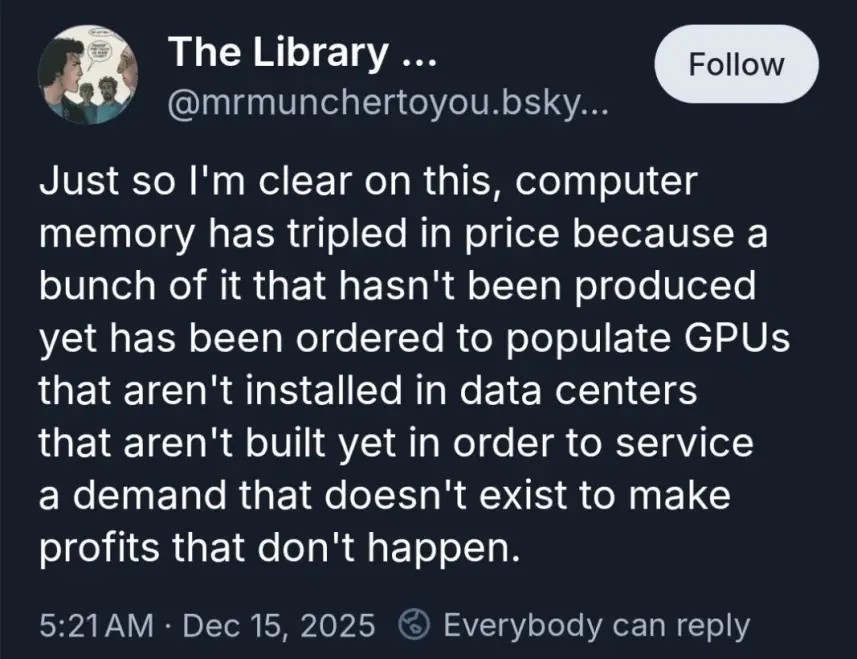
I can help:
That was the excuse for memory.
They’re also stopping production on affordable desktop graphics cards that don’t AI well.
Next up, They’re going to stop making SSD and force the price of NVMe up.
They’ve yet to release that they’re going to drive up the prices of CPU’s, motherboards and power supplies.
AI companies have found ways to force consumers to use their products against their will. These hardware vendors no longer need to compete to get you to buy, if you use a search engine, an browser, a mail service or a major social network, you’re using their stuff and the AI company buys it on your behalf. Since they can just charge you for that and you can’t do anything about that price, your purchases no longer matter.
It’s like food, cars, you know, everything but paychecks are going up in numbers.
We’re pushing the gas pedal to a boring dystopia.
Uhh. Just chiming in here as someone that does business to business IT support… Most of the NPC office workers are almost demanding access to “AI” stuff.
I’m not saying this will turn out well, in fact, I think it will probably end poorly, but I’m not on charge around here. There’s a nontrivial outcry for “AI” tools in business.
There’s profit happening with it right now. Maybe not enough to offset costs yet, but there’s a market for these things in the mindless office drone space.
To be absolutely clear, I think it’s an idiotic thing to have/use, especially for any work in IT, but here we are. I have middle managers quoting chat GPT as if it’s proof that what they want, can be done. I’ve been forwarded complete instructions to use fictional control panels and fictional controls to do a thing, when it’s not possible for that thing to be done.
“AI” is a corporate yes-man in the worst ways possible. Not only are they agreeing that something can be done, even if it’s not possible, but it’s providing real enough looking directions that it seems like what it’s proposing can be done, is actually possible and reasonable. I once asked copilot how to drive to the moon and it told me I’d run out of gas. While I would definitely run out of gas trying to get to the moon by car, when I’m done trying and I’ve run out of gas, I wouldn’t be any closer to the moon than I usually am.
The thing is an idiot on wheels at the best of times, and a blatant liar the rest of the time. I don’t know how people can justify using it in business when a mistake can lead to legal action, and possibly a very large settlement. It’s short sighted and it’s not worth the time nor effort involved in the whole endeavor.
Simply because they can read the writing on the wall. Corporate made every single decision possible to signal “use AI or get fired.” With mass layoffs being driven mainly by whole industries pivoting to AI, people are fighting desperately to stay relevant. Every pundit and tech guru is singing “learn AI or become unemployable.” It is a strive for survival, not a heartfelt trust or belief on the tech. Hell, they might not even understand how it works, people just know they need it in their CV to keep their meager income coming.
For the most part AI is the best OCR ever designed. And if used for that it really is great. Most AI agents you see our there are mostly just used for that: ocr.
It’s also nice-ish to start writing simple programs, if you know how it works it sets you more or less in the right path in a few prompts. That head start can be nice.
It also helps in Excel with charting.
It also is helpful for acquiring knowledge. AS LONG AS YOU CHECK THE LINKED SOURCES.
If you don’t you will crash and burn. Not eventually but quick.
So yes, AI does have uses and Yes, it will cost some people their jobs, especially in knowledge Industries and IT.
But then again, that’s a tale as old as time. Stuff changes.
(AI) datacenters will not go away. Desktop processing will vanish. And then, 15 years from now, someone gets a great idea and starts selling Personal AI computers. And this cycle will redo from start.
One nice thing about the current situation is we have a very effective and intuitive way to explain to gamers that capitalism is bad.
Tulip mania.
A.I. and big tech does not want you to have computing power to challenge their digital hegemony.
They will start pushing dumber and dumber devices and making development boxes so out of reach that only mega-wealth can afford to buy them.
Dumb devices will not be able to run shitty vibe coded OSes and apps. Your modern Android phones has orders of magnitude more computing power than 20 years old PDA despite having the same (or even less) functionality. Or even compared to 10 year old Android device. Software has been becoming slower and more bloated for decades, and it’s only going to accelerate with “ai”.
There will be more software restrictions and locked down “ecosystems” but I don’t see the hardware becoming weaker. There is no going back.
I uninstalled google services and shit from a 60€ android phone and boom! Now stand-by battery life is 7 days and before it was 2~ days
Microsoft and Nvidia have been trying for years to offload computing power to their own systems, while your computer becomes little more than a remote access terminal into this power when these companies allow you access to it.
See; Nvidia Now, Xbox Cloud Gaming, and pretty much every popular LLM (there are self-hosted options, but that’s not the major market rn, or the direction it’s headed)
There’s ofc struggles there, that they have had a hard time over comming. Particularly with something like gaming, you need a low latency, high speed internet connection; but that’s not necessary for all applications, and has been improving (slowly).
Software has been becoming slower and more bloated for decades and it’s only going to accelerate with “ai”.
This is mostly true, but a little misleading. (although the AI part is absolutely correct)
This is mostly a result of having more powerful hardware. When you’re working with very limited hardware, you have to be clever about the code you write. You’re incentivized to find trade-offs and workarounds to get past physical limitations. Computer history is filled with stuff like this.
Starting around the mid 90s, computer hardware was advancing at such a rapid pace that the goalposts shifted. Developers had fewer limitations, software got more ambitious and teams got larger. This required a methodology change. Code suddenly needed to be easier to understand and modify by devs who might not have a full understanding of the entire codebase.
This also had a benefit to the execs, where entirely unoptimized, or even sometimes unfinished code could be brought to market and that meant a faster return on investment.
Today we are seeing the results of that shift. Massive amounts of RAM and powerful CPUs are commonplace in every modern device, and code is inefficient, but takes up basically the same percentage of resources that it always has.
This change to AI coding is unavoidable because the industry has decided that they want development to be fast and cheap at the cost of quality.
The goal here isnt to have personal devices run the shitty vibe-coded apps, it’s to lease time in datacenters to have them run it for you and stream it to your device for a monthly fee.
It could when you’re literally just running a basic OS and everything else is in “the cloud”. Like that Windows 365 box Microsoft released recently that doesn’t actually run Windows itself
And who is going to create this perfect and resource efficient OS? Literally all tech corporations are headed in the opposite direction. All proprietary consumer OSes are getting more bloated by the hour, and their developers are being replaced with incompetent vibe coders.
Incompetent? I’ll have you know that I’m a prompt engineer. 😏
I’m not amateur. I end every query with “and no bugs, please.”
Does it at least apologize to you when it adds bugs anyway?
Imagine if people who know how to use search engine properly called themselves “search engine prompt engineer”. Maybe people who are good at communicating should start calling themselves “human interface prompt engineer”.
Social engineer
It already exists, just the shitty cut down operating systems used by existing thin clients
Yeah and the fucking FTC isn’t going to do anything about it.
We need Lina Kahn back.
What was that book again?
I don’t know but I do know that the reason Sparc boxes and Solaris/SunOS is known by people who worked in business or academia is because that there were Intel PCs that let affordable computing reach the masses even while Crystal Tower computing existed.
Now it seems that affordable PCs are not what the Mega-Wealthy want so they will make every computing device capable of creating a challenge to A.I. as expensive as possible just like Sun did with their hardware.
They can do this because the market can’t respond to make more competition. And tariffs make that worse.
For a purpose nobody wants, and will be used for mass surveillance and bleeding edge sentiment manipulation.
well hundreds of CEOs and billionaires want it. I know some that made AI their whole case to get the CEO job. Just not us normal 99% of the world
My favorite part is that even if these data centers get built, hardware to support LLMs is improving at a pretty fast rate due to the stupid amounts of money being burned on it.
This hypothetical hardware will be out of date by the time the data centers are ready for it, and they’ll either be built with out of date tech or they’ll blow past their budget due to actual differences in what it costs to make the up to date hardware vs what was planned.
My homelab welcomes the “outdated” or in need of maintenance chips coming my way.
Oh no I can’t use the latest text generation tool and all I can do it crazy simulation, 3d model, and graphics work. What a shame. /s
That said, is it possible to get cast-off equipment from the likes of Amazon or Microsoft? I wouldn’t mind some decom cloud stuff.
That’s why they’re making it expendable. Those chips are designed to survive no more than 5 years of service in data centers. An unprecedented low level of durability provisioning. They are intentionally making e-waste.
Correct. I will draw your attention to onion futures
Wow that was a fascinating read.
Very interesting story
This actually isnt that weird, happens all the time
However, its less common that it impacts a common consumer product of the same type.
But a thing to be used in making a huge project causing prices to shoot up ahead of time is very normal.
Its just usually stuff like concrete, steel, lumber, etc that is impacted the most, but turns out RAM as a global industry wasnt ready to scale up to a sudden huge spike in demand.
Give it a couple yesrs and it’ll level out as producers scale up to meet the new demand.
The producers have announced they will not increase production
They will. Otherwise they’re throwing money away and leaving room in the market for competitors.
The big problem, though is that DRAM manufacturing requires a shitton of money to make and you’d have to poach talent from existing players. Otherwise you’ll never be able to get started. It’s just too complicated.
China has been trying to catch up with Taiwan in chip manufacturing for like 20 years now and they’re still at least 10 years behind. Probably 15 or more because of the way funding/investment works over there.
Otherwise they’re throwing money away and leaving room in the market for competitors.
Nope. Their costumers are throwing so much money at AI boondoggles that wasting time, materials, and manpower on the current tech bubble is now the most profitable move for the hardware producers.
It’s the Shoe Event Horizon, except in stead of everyone being depressed and buying shoes, it’s a dozen billionaires becoming so greedy, arrogant, and shortsighted that they swallow an entire cornerstone industry for their latest obsession.
Haha, referencing the Shoe Event Horizon made me stop and pay attention!
“Shit. Maybe they’re right… We could be about to evolve into bird people!”
Right! The manufacturers know this is a bubble and aren’t going to put themselves into debt to build new factories! They’re going to ride the bubble til it pops and then try to go back to normal, but significantly richer.
“As long as the music’s playing, you’ve got to get up and dance.”
That’s Citi’s former CEO, who explained that he would devote his company’s resources to making money in a bubble (during the 2007 housing bubble), even when he knew it was a bubble.
The memory chip producers are absolutely going to try to maximize production during this bubble. The normal life cycle is to run fabs on offsetting cycles where at any given time, the company has a few fabs in the planning stages, in the construction stages, R&D stages, early “risk” production, high volume production, and retooling for a new process.
That means that during a bubble, it makes sense to try to accelerate the speed at which new fabs come online or old fabs get retooled. It makes sense to keep old fabs running longer at higher yields, even for previous generation product. These aren’t mature businesses that were already planning on running the same factories forever. They already anticipate the cycle of multiple generations, and what that looks like is going to be more aggressive during periods where customers are throwing money at them.
I just don’t understand how selling everything they produce increases costs. Are they just charging more for more profits, or is the increased prices funding increased production?
The vast difference in economics between retail and manufacturing don’t make sense to me.
Easy. They always sell the amount they produce. However only when they lower the price. Nobody with a sane mind pays 150 € for 8GB of RAM.
However what if they already sold everything and even future products to someone and have the money already? Well now you have the same demand but no supply. Of course demand falls with increasing prices, but your supply is so limited that you want to reach the sweet spot where someone still pays that much for it and where you still sell everything you have left.
Let’s say I harvest 100 apples a year and my neighbours buy 70 each year I basically only charge as much as it costs me to harvest them so I have a little winnings. Because if not they will buy from someone else.
But now someone buys all the apples he can get. Now I sold 98 apples and my neighbours still want to buy 70. Well at some price they will only want to buy 2.so I charge 500 per apple, because I am greedy.
A bigger share of the current factory output is being routed to the tech companies rather than the consumer component shops meaning there’s less to go around. Since there’s less to go around, consumer-facing stores are forced to bid higher to be able to maintain their stock which is then passed on to us plebs
At that scale it’s kind of like an auction for the capacity to produce the chips (and it’s the DRAM chips, not the finished modules in this case).
So for a DIMM retailer to get enough chips to make a product they need to out bid Nvidia :-(
My micro economics would tell me it’s that the demand curve is shifting upwards, while the supply curve is at best the same, of not going lower (currently), so the intersecting price where they meet goes up. While it may be artificial, more demand on the same supply increases prices typically. Depending on the elasticity of the demand for the product (toys VS household electricity costs for example), the market will bare the increases if it deems it essential.
But those were lessons from 15 years ago, this brave new world of open corruption and greed have probably up ended some of those concepts. The circular fake economy of a half a dozen tech companies can probably only sustain itself for so long, I guess we’ll see how it all pans out
It is happening to cars as well. Eventually you will only be able to rent a car and pay for each feature by the minute. Features such as brakes, lights, windshield wipers…
As long as I can still own a bicycle
This is arguably the best, brief Analysis of Bullshit that I’ve ever seen.
Bluesky user discovers futures
That’s not entirely fair, though. The key part of the statement is, “to service a demand that doesn’t exist.” The problem with AI is that there is little user demand for it, so all the capacity being aggressively built is going to eventually hit a brick wall.
I shouldn’t say there is little user demand. There is little paying user demand, but that’s the thing that makes and breaks investments the size of these. Enshittification is built-in, and for a change the cost of the data centers is a visible reminder that someone is going to pay, eventually.
Given the size of the players involved and their political connections, I assume the chump is going to be the tax payer in the end. That is going to be fun to watch: billionaires getting a massive bailout while you are getting kicked out of health insurance.
The key part of the statement is, “to service a demand that doesn’t exist.”
But that’s basically always true of big projects. The people financing the project believe that the demand will exist in the future, and know it will take time and investment of resources to get to the point where they will meet that future demand.
They can be wrong on their projections of future demand, but that happens all the time, too. A classic example is when a city hosts the Olympics or World Cup and builds out a lot of infrastructure to meet that anticipated demand for both that specific event and the long term needs of the resident population. Sometimes it works, like with certain mass transit systems expanded for those events, and sometimes it doesn’t, like when there are vacant stadiums sitting underused for decades after.
Or, the analogy I always draw is to the late 90’s when telecom was building it a bunch of fiber networks for the anticipated future demand for Internet connections. Most of those ended up in bankruptcy, with the fiber assets sold for a fraction of the cost of building them. But they still ended up being useful. Just not worth the cost.
I think the same will happen with a lot of the data center infrastructure. Data centers will still be useful. A lot of the infrastructure for supporting those data centers (power and cooling systems, racks, network connections) will still be useful. There’s just no guarantee that they’ll be worth what they cost to build. And when that happens, we might see a glut in used data-center-grade computing equipment, and maybe hobbyists will score some deals at auctions to make their own frankenservers for their own purposes, and completely blow normal homelabbing out of the water.
You are absolutely right in the overarching logic, but I believe we have interacted with the current iteration of AI long enough to know that consumer demand is underwhelming, and ROI for enterprise investment is near zero.
In your Olympics analogy, it would be like every four years a city spending tons of money on Olympic games that attract a lot fewer visitors than predicted, just because the other cities did in the past.
Honestly, I am reminded of the early days of the Internet, when all VCs were funding “generic sales startup” because they had said No to Bezos and Amazon had exploded. It wasn’t about making a good investment, it was about being able to say they hadn’t slept on the biggest opportunity they in fact missed.
All those data centers will be of little use. The components used are deliberately e-waste, designed to die in 5 years or less. The rack space is the cheapest part and if there’s no demand, they will be quickly deprecating real state. Anything built will be demolished and sold as soon as the bubble bursts. That’s their usual destiny, as data centers are not a very profitable for lease space.
Part of the reason why it may seem like there’s little paying user demand is that you may be thinking of demand in terms of individual consumers as the source of demand. However there is also the world of B2B, where I imagine the bulk of demand is coming from. Business requirements for service tend to be more extensive and they will pay for it.
And the fact that it’s normalized to someone like you is a bigger problem.
It’s not even futures, just basic demand through scarcity.
There is an expectation that there will be a severe shortage of RAM soon, which causes people to panic buy it now, which drives prices up. It’s not that complicated.